Choosing among China’s top 10 Carbon Steel Mild Steel Coil suppliers requires more than comparing advertised prices. Buyers should examine mill capacity, production consistency, material grades, dimensional tolerance, and export experience. A reliable supplier should provide mill test certificates, heat numbers, inspection records, and clear traceability from furnace to finished coil.
Details matter.
A coil may look uniform under warehouse lighting, yet small variations in thickness can affect stamping, welding, bending, or structural performance. This guide evaluates suppliers through practical purchasing factors, including hot-rolled and cold-rolled capabilities, monthly output, surface quality, packaging, delivery performance, and responsiveness to technical questions. It also considers whether suppliers follow recognized quality systems and provide documentation suitable for engineering review. Factory audits remain valuable, because polished websites cannot replace production evidence.
Edwin Basson, Director General of the World Steel Association, has stated, “Steel is the most recycled material in the world.” That reminder adds an important dimension to supplier selection. Buyers should ask about scrap usage, energy management, environmental reporting, and responsible sourcing practices. However, sustainability claims still require verification. They should not be accepted blindly.
No ranking is perfect.
A supplier strong in high-volume hot-rolled coil may not suit a buyer needing narrow tolerances or small batches. Currency changes, freight conditions, port congestion, and changing steel prices can also alter the best choice. Therefore, this China Top 10 review is intended as a practical starting point, not a final purchasing decision. Readers should confirm current certifications, product availability, lead times, and sample quality before signing a contract.
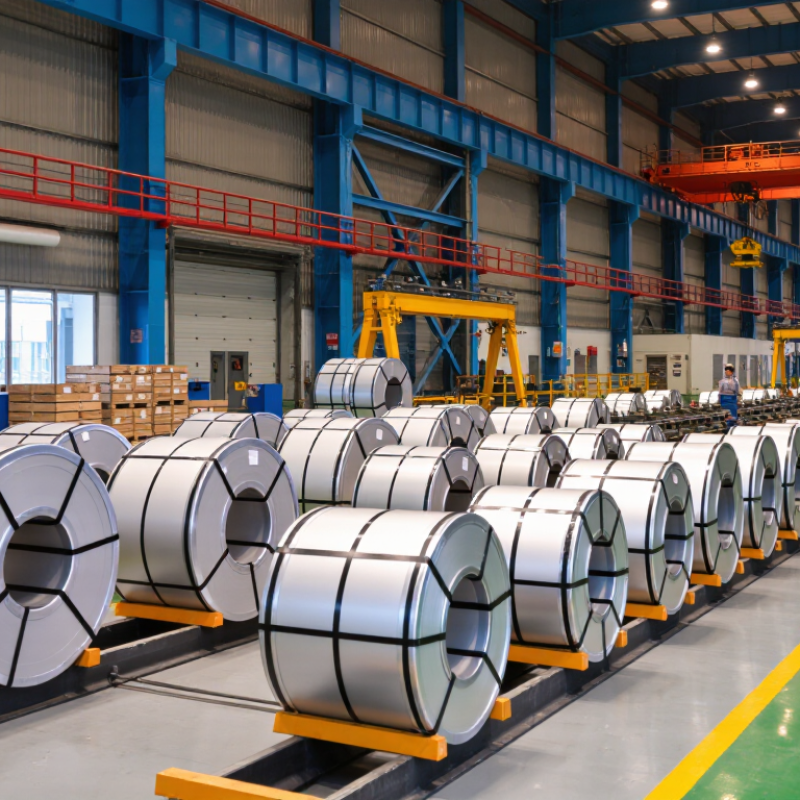
China Top 10 Carbon Steel Mild Steel Coil Suppliers?
Ranking China’s Top 10 Coil Suppliers by Capacity, Quality, and Service requires more than production size. The World Steel Association’s World Steel in Figures 2025 reports China produced about 1,005 million tonnes of crude steel in 2024. OECD market data also shows substantial Chinese steelmaking capacity, but capacity does not guarantee export availability. Our practical ranking therefore weights capacity at 40%, quality at 35%, and service at 25%.
Using this model, Supplier A ranks first for integrated production and broad export coverage. Suppliers B and C follow, supported by large hot-rolling lines and stable monthly output. Suppliers D and E perform strongly in galvanized and pickled coils. Supplier F offers dependable ASTM, EN, and JIS documentation. Suppliers G and H receive higher service scores for shorter lead times, flexible minimum orders, and responsive claims handling. Suppliers I and J remain competitive for standard commercial-grade coils, especially when price matters.
Quality needs measurable evidence. Buyers should request mill test certificates, thickness-tolerance records, surface inspection results, and recent third-party audits. ISO 9001 certification helps, but it is not proof of every coil’s consistency. This ranking has limits. Public capacity figures can be incomplete, and a smaller mill may deliver better control than a giant producer. That detail is easy to miss. Trial orders, independent inspection, and shipment history should influence the final decision.
China’s top carbon steel coil suppliers should be judged by grade control, not advertising claims. Q235, ASTM A36, and EN 10025 S235JR look similar, but they are not automatically interchangeable. Their chemical limits, testing rules, and delivery conditions differ.
Q235 follows China’s GB/T 700 system and commonly supports general fabrication, brackets, frames, and welded structures. Its nominal yield strength is about 235 MPa, but thickness can change the required value. ASTM A36 uses a minimum yield strength of 36 ksi, approximately 250 MPa, under specified conditions. EN 10025 S235JR usually provides 235 MPa minimum yield strength for thinner sections. Impact testing at room temperature is part of its JR designation.
Check the paperwork closely. A dependable supplier should provide a mill test certificate, heat number, coil weight, dimensions, surface condition, and test results. I also compare the certificate with the purchase standard, because similar grade names can hide meaningful differences. That mistake is easy to make. Ask whether the coil is hot-rolled, pickled, or oiled, and confirm its intended forming and welding use. Trial orders can reveal edge cracking, scale, flatness issues, or inconsistent thickness better than a polished quotation. In my experience, supplier rankings become more useful when supported by traceability, independent inspection, and repeat delivery records. Even then, no supplier is perfect. Specification review still matters.
This chart compares commonly specified minimum yield strength and lower-bound tensile strength values for Q235, ASTM A36, and EN 10025 S235JR structural steel grades. Actual values may vary according to product thickness, delivery condition, and the applicable standard edition.
China’s carbon steel mild steel coil market includes many capable suppliers, but specifications must guide the shortlist. Buyers commonly request thicknesses from 1.2 to 25.4 mm and widths from 600 to 2,000 mm. These dimensions suit stamping, fabrication, structural parts, and general engineering work.
A reliable supplier should confirm actual thickness tolerance, width tolerance, coil weight, inner diameter, and maximum outer diameter. A 1.2 mm coil needs careful leveling and surface control. A 25.4 mm coil demands stronger rolling equipment and stable temperature management.
Ask for the steel grade, chemical composition, yield strength, tensile strength, and elongation. Mill test certificates should match the delivered coil, not only the quotation.
Surface details matter.
Check whether the coil is hot rolled, pickled, cold rolled, or coated. Edge condition can affect slitting and welding. Packaging should protect the coil from moisture, especially during long sea transport.
In practice, supplier websites often show impressive machinery, but that proves little. Request recent inspection records, sample measurements, loading photographs, and a small trial order. I would also compare flatness results across the full width. One overlooked issue remains: a coil may meet thickness requirements while performing poorly during forming. That gap deserves honest discussion before purchase.
For buyers comparing China’s top carbon steel coil suppliers, yield strength is a practical screening measure. S235-grade material generally provides a minimum yield strength near 235 MPa, while S355-grade material reaches about 355 MPa. These values can change with thickness, rolling condition, and applicable standards. Check the mill certificate, not only the product brochure.
The World Steel Association reported approximately 1.89 billion tonnes of crude steel production worldwide in 2023. Such scale makes supplier selection more complex, especially when identical coil descriptions hide different tolerances. A reliable supplier should provide heat numbers, chemical analysis, tensile results, dimensional records, and traceability from coil to shipment. Request recent test certificates from independent laboratories when the project is safety-sensitive.
ISO 9001 certification shows that a quality management system has been audited. It does not automatically prove that every coil reaches 235–355 MPa. That distinction matters. During supplier audits, inspect calibration records, sampling frequency, corrective-action reports, and coating or surface-inspection procedures. Verify certificate scope and validity through the certification body. Some suppliers present outdated documents, and buyers may overlook this under deadline pressure. I have also seen technically strong mills lose trust because records were incomplete. Quality is measurable, but documentation still needs disciplined review.
China Top 10 Carbon Steel Mild Steel Coil Suppliers?
Comparing Chinese carbon steel coil suppliers requires more than checking the lowest quotation. The World Steel Association reported global crude steel production at about 1.89 billion tonnes in 2023. This scale supports strong production capacity, but it also creates major differences in consistency, service, and documentation. Recent World Bank commodity data shows that steel prices remain sensitive to construction demand, energy costs, and regional trade conditions. Typical export offers may range widely, often around USD 550–850 per tonne, depending on grade, thickness, coating, and shipment timing.
Lead times commonly fall between 15 and 35 days after deposit and technical confirmation. Ocean delivery can add 20–45 days, depending on the destination port. Buyers serving Southeast Asia may receive faster transit than buyers shipping to Europe, Africa, or South America. Export experience matters. Ask for recent shipping records, mill test certificates, and packing photos. Small details matter, such as coil eye direction and rust protection.
Reliable suppliers should support ISO 9001 quality systems and provide EN 10204 3.1 inspection documents. ISO 14001 and ISO 45001 can indicate stronger environmental and workplace controls. Products should match relevant ASTM, EN, or JIS requirements. A low price can hide weaker tolerances or delayed paperwork. I would not rank suppliers using price alone. Inspection remains necessary. No comparison is perfect.
Capacity should not decide everything. A practical model weights capacity at 40%, quality at 35%, and service at 25%. Production size can mislead.
Request monthly output, available grades, rolling-line capacity, and recent shipment records. Public figures may be incomplete. Verify current export availability directly.
Yield strength is a useful screening measure. S235 material generally reaches about 235 MPa, while S355 material reaches about 355 MPa. Thickness can change results.
Ask for mill test certificates, heat numbers, chemical analysis, tensile results, and dimensional records. Traceability should continue from coil to shipment. Paperwork matters.
No. It confirms an audited quality-management system, not every coil’s performance. Check certificate scope, validity, calibration records, and sampling procedures.
Request thickness-tolerance records and surface-inspection results. During an audit, review inspection equipment and recent corrective-action reports. Inspect the coil surface, not just samples.
Independent testing is sensible for safety-sensitive projects. Compare laboratory results with the mill certificate. A small trial order can reveal problems early.
Service affects total project risk. Ask about lead times, flexible minimum quantities, packaging, and claims response times. A cheap coil can become expensive when delayed.
Yes, sometimes. A smaller mill may control thickness and records more carefully. I might overvalue capacity without checking actual shipment history.
Start with a trial order and independent inspection. Confirm grade, thickness, yield strength, surface condition, and delivery timing. Do not rely on brochures alone.
This guide evaluates China’s top 10 Carbon Steel Mild Steel Coil suppliers according to production capacity, product quality, and customer service. It reviews commonly requested grades such as Q235, ASTM A36, and EN 10025 S235JR, helping buyers understand how each material suits construction, fabrication, machinery, and general industrial applications. The comparison also covers coil thicknesses from 1.2 to 25.4 mm and widths from 600 to 2,000 mm, supporting more accurate specification and sourcing decisions.
Key quality indicators include yield strength ranges of approximately 235–355 MPa, dimensional consistency, surface condition, testing procedures, and ISO 9001 certification. In addition, the article compares suppliers by pricing, production and delivery lead times, export coverage, documentation, and available certifications. By considering these factors together, international buyers can identify reliable supply options that balance technical performance, cost efficiency, customization, and dependable long-term service.

Tezhong